This One Skill Could Make or Break Your Kids Adulthood – and You Can Teach it to Them
One valuable life skill could make a huge difference in how happy, satisfied, and stress-free your child is as an adult. (Hint – it has to do with money)

Let’s get one thing straight – I teach my kids about money not so they’ll eventually have flush bank accounts or land a spot on Million Dollar Listing or one day fly cross-country in their private jet.
I’m passionate about teaching my kids about money because I know it can make or break their adulthood.
No matter how much money a person earns, how they manage it can determine how happy, content, and worry-free their adult lives will be. Research shows that people who know how to manage their money are happier, more satisfied with their lives, and experience fewer negative emotions.
Because even if someone earns bucket loads of cash, if they don’t manage that money well, they can still end up in debt or worse, bankruptcy.
I’ve seen it happen among friends and family – adults who dreamed of pursuing a profession they felt passionate about but chose another job just to support their debt and lifestyle.
One relative, who despite pursuing social work and then freelance photography, learned how to live within her means – in New York City. She didn’t open a credit card account until well into her 30s (when she had to rent a car for work), has lived debt-free, and best of all, has lived the life she’s chosen, not the one she’s been forced into.
I want that for my kids.
This is the Key to Setting Kids Up for Financial Success
So for me, teaching my kids good money habits means giving them a chance at a happy and successful future. Even more so than landing a well-paying job.
Because even if someone is wealthy, it doesn’t necessarily mean they’re financially secure.
Managing and saving money is hard – really HARD – regardless of one’s salary. In the world we live in, “wants” are quickly turned into perceived “needs,” and available credit makes it possible to purchase nearly anything we desire.
Saving money takes discipline. And like anything that needs discipline, the habit of saving money and making wise spending choices requires practice – lots and lots of practice.
Here’s the Exciting Part
There’s a fairly easy way for kids to begin this practice even at a young age – with an allowance.
As with most lessons, we can try till we’re blue in the face to tell our kids what we think or want them to do. But until they actually experience these lessons themselves, they’re not going to stick.
That’s where an allowance comes in – it allows kids to experience at a young age the hardship of saving for short-term goals, the disappointment of being caught short of cash, and the feeling of buyer’s remorse, just to name a few.
By giving kids a small amount of money each week or month, coupled with handing over specific spending responsibilities, even young children can begin to learn what it takes to be a smart money manager.
How to Get Started with Allowance
Getting started with an allowance requires a bit of up-front work from parents, but once it’s set up, giving kids an allowance becomes a part of everyday life.
To begin – decide whether you want to give your kids a weekly allowance or a monthly allowance and how much you want to give them.
The timing of when kids receive their allowance (weekly or monthly) doesn’t matter much, just make sure the amount of your kids’ allowance is enough to let them be responsible for certain expenses and small enough so they aren’t flush with cash. Create a situation where they need to make tough choices, but not tough enough that they’ll never reach a desired goal.
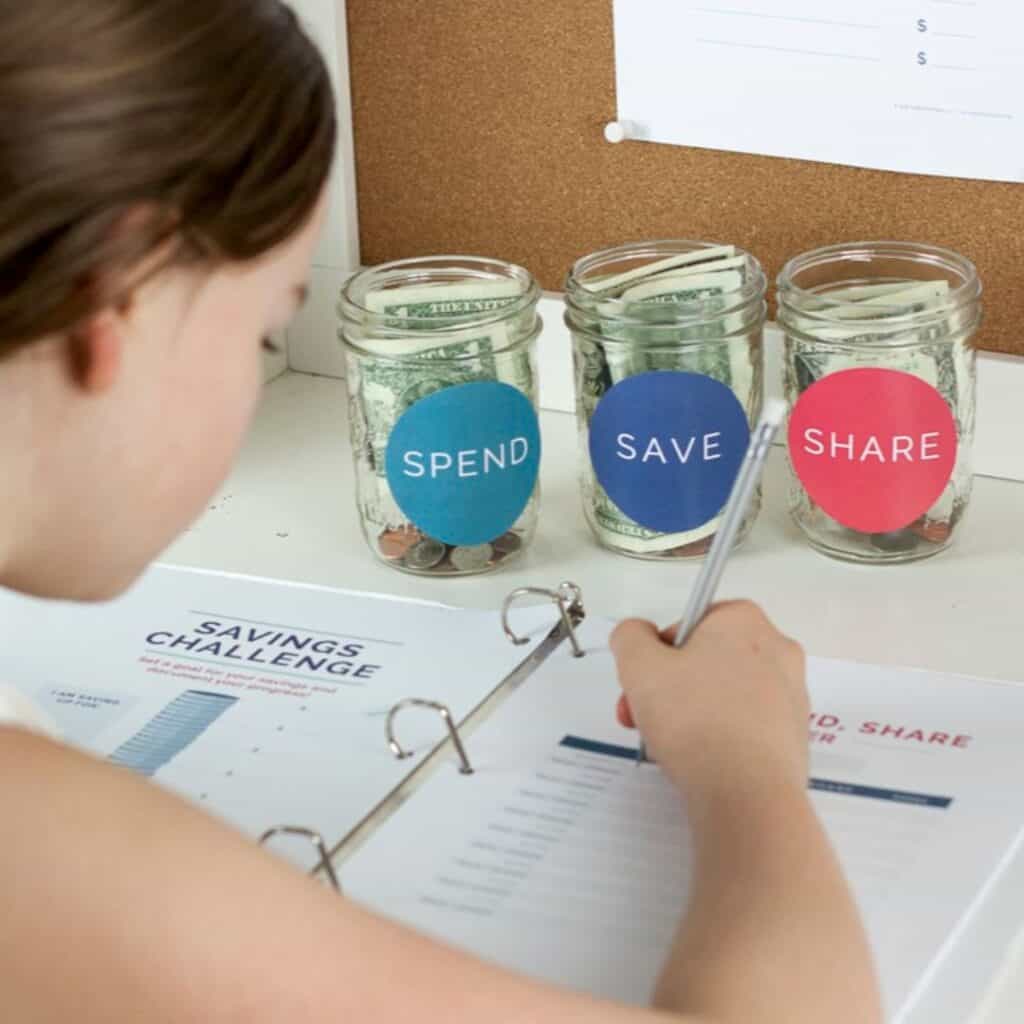
Next, rather than just handing a few bills over to your kids, this is an excellent opportunity to begin teaching them a few budgeting skills. One way to accomplish this is to place their money into three jars each time you give them allowance:
- A “Spend” jar for items they want to purchase right away.
- A “Save” jar for money they want to set aside for a big purchase.
- A “Give” jar to encourage kids to set aside part of their money to help others.
Creating these jars is easy – buy a few glass mason jars (which allows kids to see how much money they have) and add labels to the outside of each jar. These labels can be as fancy or as simple as you want them to be.
The Kids Money Management Toolkit has everything you need (except money!) to begin giving your kids an allowance. In addition to guidance and advice, you’ll also receive Save, Spend, and Share jar labels, a Kids Money Ledger, a Savings Challenge Sheet, a Jobs-for-Hire Sheet, and a Kids Allowance Contract. Click here to learn more.
6 Best Practices for the Save, Spend, Give Three-Jar Method:
In order to make allowance a successful learning experience for your kids, here are a few best practices to consider:
- Pick a Day: Pick a day and general time when you’ll give allowance and stick with it. For us, my phone alarm reminds me at 7 am on Sunday morning it’s allowance time.
- How much to give: If you want to keep it simple, start with three dollars a week – one for Spend, one for Save, and one for Give. But if your child is older, add up the expenses you plan to hand over to them and back into an amount. (For ideas on which expenses your child can start paying for see: 7 Things You Should Stop Paying for Once Your Kid has an Allowance.)
- How to Split Allowance into 3 Jars: Common advice is to divvy up allowance by percentages (for example, 10% in Give, 20% Save, 70% Spend), but I’m not in the mood to count out coins. So instead, my division of the money is a lot less precise and goes something like this: For a $6 allowance, $1 goes to Give, another dollar to Save and the rest to Spend. For an $8 allowance, $2 goes to Give, $2 Save, and $4 to Spend. Yes, a higher percentage of one girl’s allowance goes to donations and savings, but dealing with change each week is not in the cards for me. To see what else I do to teach my kids budgeting skills see: How to Teach Kids to Budget Their Money
- Limits to Spending: Ideally, you want to give your kids free reign when it comes to spending. Let them buy the cheap junky toys. Eventually, they’ll learn that cheap toys don’t last long and aren’t very satisfying. Of course, you still have the authority to nix items you think are inappropriate.
- How to Manage Savings: It’s a good idea to think through how the Save jar will be different from the Spend jar. What will distinguish the two? Will your child receive interest payments on savings? Or only be allowed to access savings once a week? To read about the trial and error I went through with my kids Save jar see: How to Teach Kids to Save Their Money
- How to Manage the Give Jar: Determine an amount, say $20, when you will clear out this jar and have your kids donate this money. You may find that this exercise is confusing at first for young kids (What? I have to give money away to someone else?!) but letting them research and choose where to donate their money can turn it into a fun activity. See related posts: 7 Tips to Encourage Your Kids to Donate Money and 8 Charities That Will Inspire Your Kids to Give
A Glimmer of Hope
A few weeks ago it happened – a slight indication that this allowance thing might be paying off.
My daughters and I had taken a special trip into the city and ended up in a museum gift shop. There among the beautiful scarves and artistic prints were plentiful kids trinkets, books, and toys – my kids were in heaven.
As we walked among the stuffed animals and colorful craft kits, my eldest picked up a pack of glitter pen markers in unusual colors like burnt orange and aqua blue – a real temptation for a kid who can spend an entire afternoon drawing, painting, and coloring.
“Mom, Look at these! Can I get them?” She asked.
“With your allowance,” I said.
Her face showed her disappointment as she looked at the package again and noticed the price of $12.
After pondering her decision for a few moments she carefully placed the package back on the shelf and said: “But I’m only $20 away from getting a Lego Friends Private Jet.” And with that, she was done. She had experienced temptation and overcame it. She’d delayed gratification and learned an invaluable lesson. I was thrilled.
I also decided that having your daughter save up for a private jet wasn’t always a bad thing after all.
You Might Also Like:
One Brilliant Thing My Parents Did That Turned Me Into a Money-Savvy Adult
Kids Won’t Understand Money Until You Do This
Everything Your Child Needs to Know About Money Before Leaving Home
About Kerry Flatley

Kerry Flatley is the owner and author of Self-Sufficient Kids. She has a BA in economics, an MBA, a certificate in financial planning, and has been investing ever since she landed her first job. Kerry also has two girls, ages 13 and 15, who have been receiving allowance – and learning money management – for the past seven years.